
Drains · 6 min read
Kitchen Sink Not Draining in a Miami Condo? Disposal, Trap, or Stack
A kitchen sink that holds water is telling you where the blockage is, if you know how to listen. Here is how to separate a jammed disposal from a clogged branch line from a shared condo stack in Miami-Dade.
By The God Plumber · Florida plumbers with ten years of hands-on experience · Published · Updated
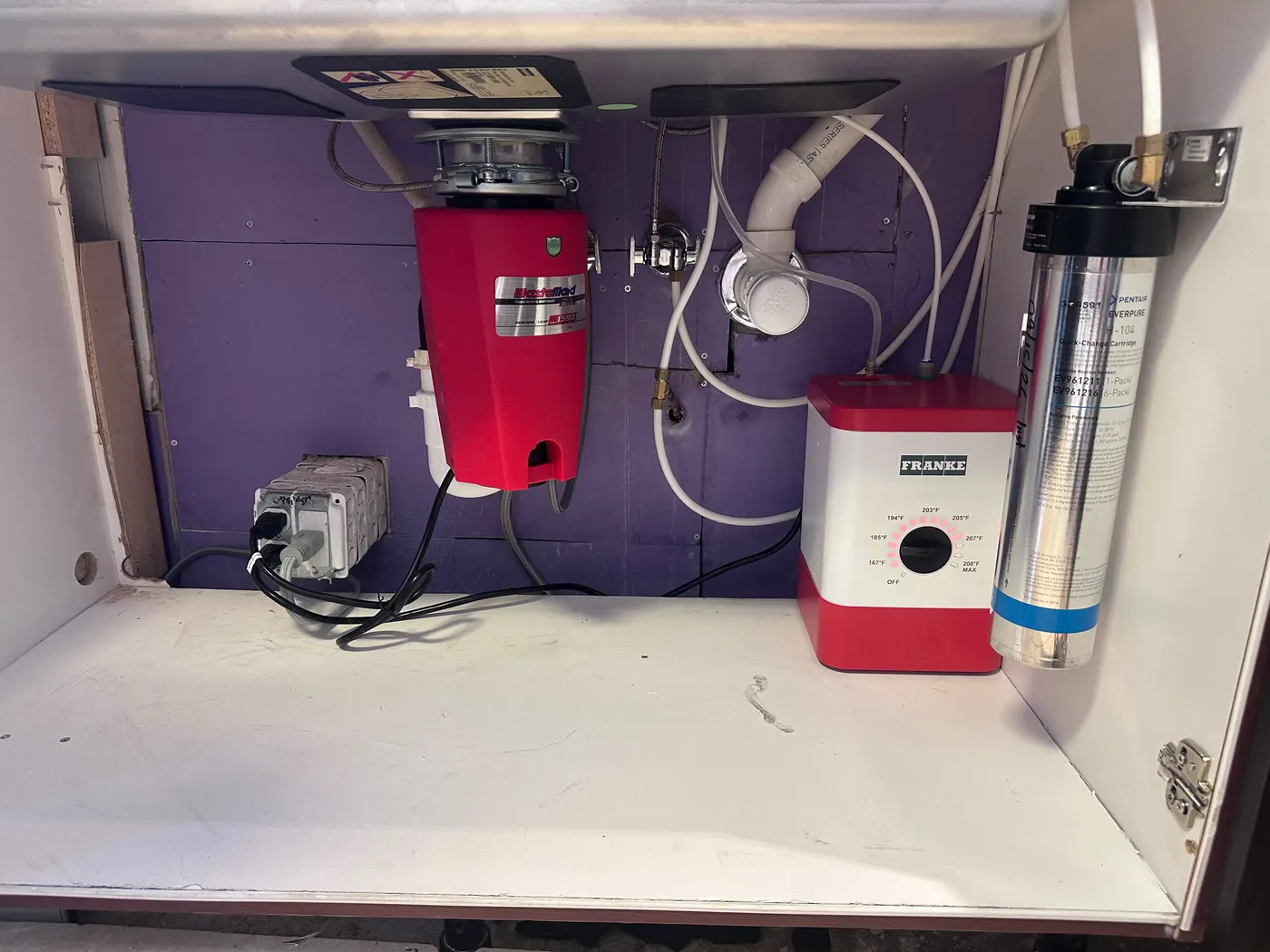
If your kitchen sink will not drain, the blockage is in one of three places, and you can usually work out which one from the kitchen itself: inside the garbage disposal, in the trap and branch line under the cabinet, or in the vertical stack your whole building shares. A disposal that hums but does not spin is jammed. A disposal that grinds normally while the water just sits is telling you the clog is past it, further down the pipe. And if a neighbor above or below you has the same slow sink in the same week, the problem belongs to the building rather than to your unit.
That split matters in Miami-Dade more than in most places, because so much of the housing here is stacked. In a condo tower in Aventura or on Miami Beach, your kitchen drain is a short branch tying into a vertical stack shared with every unit in your column. In a single-family house in Kendall or Doral, the same drain runs out through a slab. Same symptom at the sink, different work underneath — and different answers about who pays for it.
Is it the disposal or the drain?
Run the disposal with cold water on and listen. What you hear separates a machine problem from a pipe problem:
- A loud hum with no grinding — the flywheel is jammed. Switch it off; letting it hum trips the overload and can cook the motor.
- Nothing at all, not even a hum — that is power, not plumbing. Check the reset button underneath, then the wall switch, then the breaker.
- Normal grinding, water still standing — the disposal is fine and the clog is downstream, in the trap or branch line.
- Water rising in the other basin or backing into the dishwasher — the blockage is past where both sides join, so it is a pipe job.
- A slow sink in your unit and in the units above or below you — that points at the shared stack, the association's line rather than yours.
What to try before you call anyone
- Cut the power at the wall switch and the breaker before your hands go near the disposal.
- Free a jam with the hex wrench that came with the unit: fit it into the socket in the center of the underside and work it back and forth until the flywheel turns freely. A broom handle levered against the grinding plate does the same job. Pull out whatever you can see with tongs.
- Restore power, press the reset button, then run cold water and switch the disposal on in short bursts.
- If water still stands, put a bucket under the trap, unthread the slip nuts by hand and clear it. A surprising share of kitchen clogs live in that one bend.
- Stop there. If the trap is clear and the sink still holds water, the blockage is further along the branch or in the stack, and that needs a cable or a jetter.
Two things to skip. Never reach into a disposal, even with the breaker off — use a wrench, tongs or a broom handle. And do not pour chemical drain cleaner into a standing sink: it rarely moves a grease clog, it works on old cast iron and rubber gaskets while it sits there, and it leaves caustic water for whoever clears the line.
Why Miami-Dade kitchens clog the way they do
Grease is most of the story, and it works out of sight. Warm dishwater carries fat down as a liquid, it cools against the pipe wall and sets there, and every wash adds another layer until the opening is the width of a straw. In a shared stack that build-up is cumulative across dozens of kitchens, which is why a tower runs quietly for years and then backs up on several floors inside a month. Miami-Dade County's guidance to residents is blunt: keep fats, oils and grease out of the drain altogether, and do not chase them with hot water and soap, which only hardens them further down the line.
Building age adds to it. Plenty of kitchens in Little Havana, Miami Shores and the older parts of Miami Beach still drain into cast iron that went in before 1975. Decades of scale leave those pipes rough inside, and rough pipe holds grease the way a brick wall holds paint. Hard water off the Biscayne aquifer adds its share, bound up with soap. None of that means the pipe has failed. It does mean a line in a 1960s building needs clearing more often than one in a 2015 tower, and that a cable which only punches a hole through the clog will be back.
What a disposal can actually handle
A disposal is a grinder for what comes off a plate — soft scraps, small trimmings, plate rinsings, with cold water running the whole time. It is not a way to get rid of food. The list behind the repeat visits is short:
- Grease, oil and fat — the biggest cause of kitchen clogs. Wipe pans with a paper towel and pour cooled oil into a sealed container in the trash.
- Rice, pasta, oatmeal and flour — they swell and turn to paste in the trap.
- Coffee grounds — they pack down into a sediment that holds everything else.
- Fibrous scraps: celery, corn husks, onion skins, potato peels in quantity. The strings wrap the flywheel and jam it.
- Bones, fruit pits, shells, and anything that was never food.
When the clog is the building's problem, not yours
In most Florida condo documents the drain line inside your unit is yours and the shared stack is the association's, so it is worth knowing which one you have before anyone bills for it. The tell is other units. If your sink is slow and nobody else's is, the work sits on your side of the wall. If several units in your column are slow, or water rises in the lowest unit when an upper floor drains, that is the stack, and the call belongs with the association. Either way we write down what we found and where, with photographs on the invoice — the documentation a board or a property manager needs. Read your own declaration rather than taking our word for the split; buildings differ.
Repair the disposal or replace it?
A disposal that jams, resets and runs again has years left in it. Replacement starts to make sense when the unit leaks from the body rather than a connection, when the motor trips its overload on ordinary loads, or when it grinds slowly and loudly from a worn plate and grind ring. A builder-grade unit in a busy kitchen wears faster than the same model in a two-person household. If replacing it is the honest answer we will say so, and if a wrench and twenty minutes is the answer we will say that.
If the trap is clear and the sink still holds water, or the disposal has jammed three times this year, call the South Florida line at 954-594-1666 or book a visit at a time that suits you. We will tell you whether the clog sits in your unit or in the building's stack, and the price goes in writing before work starts.